Persistent omphalomesenteric duct in an infant. Clinical case study
DOI:
https://doi.org/10.58597/rpe.v4i4.120Keywords:
Omphalomesenteric duct, vitelline duct, umbilical granuloma, exploratory laparotomyAbstract
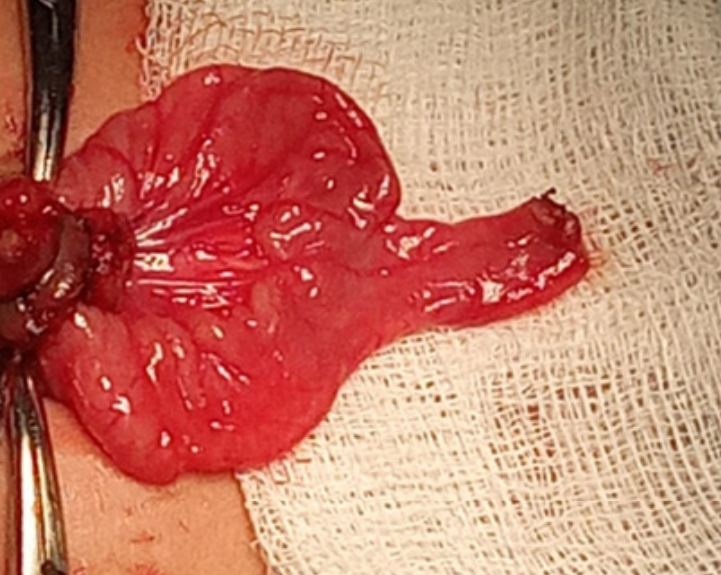
Persistence of the omphalomesenteric duct is a rare congenital anomaly. Persistent umbilical discharge is a finding that may occur in neonates and infants, and while in some cases it responds to medical treatment, others require surgical intervention. We present the case of a two-month-old infant diagnosed at birth with an umbilical granuloma, whose symptoms persisted despite treatment with silver nitrate. Due to the lack of clinical improvement, an exploratory laparotomy was performed, revealing a patent omphalomesenteric duct. Resection of the affected segment and ileal anastomosis were carried out. The patient had a favorable postoperative course and was discharged five days after the surgery. This case highlights the importance of considering this entity in the differential diagnosis of apparent umbilical conditions, as it may mimic benign lesions and hinder early identification.
Downloads
References
Inarejos Clemente EJ, Navarro OM, Navallas Irujo M, Ladera E, Colombo C, Suñol M, et al. Omphalomesenteric Duct Anomalies in Children: A Multimodality Overview. Radiographics. 2021;41(7):2090-2110. doi: 10.1148/ rg.2021210048.
Hu YY, Jensen T, Finck C. Surgical conditions of the small intestine in infants and children. In: Elsevier eBooks [Internet]. 2019. p. 970–90. doi:10.1016/b978-0-323-40232-3.00083-2.
Lovely CB. Animal models of gene–alcohol interactions. Birth Defects Research. 2019;112(4):367–79.doi:10.1002/bdr 2.1623
Carro G, Urroz J, Juambeltz C. Persistencia de conducto onfalomesenterico permeable. Anfamed. 2018; 5(2):102–7. doi:10.25184/anfamed2018v5n2a1
Rouma BS, Lakhoo K. Vitelline duct anomalies. En: Springer eBooks [Internet]. 2020. p. 671–7. doi:10.1007/978-3-030- 41724-6_64.
Solomon-Cohen E, Lapidoth M, Snast I, Ben-Amitai D, Zidan O, Friedland R, et al. Cutaneous presentations of omphalomesenteric duct remnant: A systematic review of the literature. Journal of the American Academy of Dermatology.2019; 81(5):1120–6. doi: 10.1016/j. jaad.2019.02.033
Branco VGC, Sousa CEC, Morgado FEF. Persistência Do Conduto Onfalomesentérico. 2020. Cadernos Da Medicina. 2020; 3(1):39-45. Disponible de: https://revista.unifeso.edu.br/ index.php/cadernosdemedicinaunifeso/article/view/2246
Sánchez-Castellanos ME, Sandoval-Tress C, Hernández- Torres M. Persistencia del conducto onfalomesentérico. Diagnóstico diferencial de granuloma umbilical en la infancia. Actas Dermo-Sifiliográficas. 2006;97(6):404–5. Disponible de: https://www.actasdermo.org/es-persistencia-del-conducto-onfalomesenterico-diagnostico-articulo-13091532
Zhou B, Lai H, Lin Y, Mo X. Omphalomesenteric duct remnant adenocarcinoma in adults: a case study. Springerplus. 2016;5(1):2027. doi: 10.1186/s40064-016-3713-0.
Ouladsaiad M, Aballa N, Kamili EOEA, Fouraiji K. Unusual Ileal Anomalies Associated with Omphalomesenteric Duct Remnants. Afr J Paediatr Surg. 2017;14(2):32-33. doi: 10.4103/ ajps.AJPS_67_16.
Downloads
Published
Issue
Section
License
Copyright (c) 2025 Juan Carlos Montes-Chávez, Luis Helguero-Santin

This work is licensed under a Creative Commons Attribution 4.0 International License.