Factors associated with a high risk of sleep-disordered breathing in patients with attention-deficit/hyperactivity disorder at the specialized pediatric institute of Peru
DOI:
https://doi.org/10.58597/rpe.v5i3.150Keywords:
Attention Deficit Disorder with Hyperactivity, Sleep-Disordered Breathing, Sleep Apnea, Obstructive, Child, AdolescentAbstract
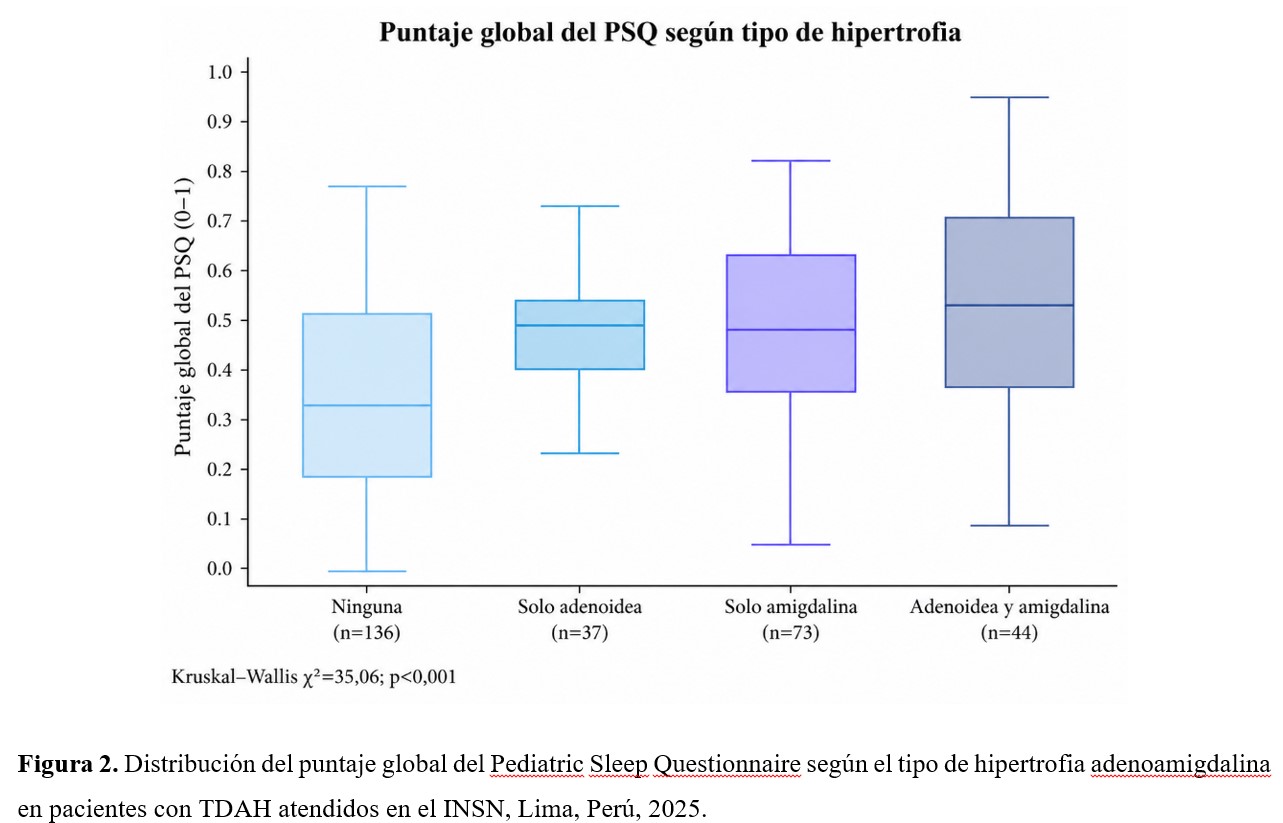
Objective: To determine the factors associated with a high risk of sleep-disordered breathing (SDB) among patients aged 4 to 17 years with attention-deficit/hyperactivity disorder (ADHD) treated at the National Institute of Child Health in Lima, Peru, in 2025. Materials and methods: An observational, analytical, cross-sectional study was conducted among patients aged 4 to 17 years with ADHD. High risk of SDB was assessed using the Pediatric Sleep Questionnaire (PSQ), with a score ≥0.33 considered indicative of high risk. Adjusted prevalence ratios (aPRs) were estimated using generalized linear models with a Poisson distribution, log link function, and robust variance. Statistical analyses were performed using Stata version 17. Results: A total of 290 patients participated, of whom 65.5% were classified as being at high risk of SDB according to the PSQ. In the multivariable analysis, the outcome was associated with residence in Lima (aPR=1.41; 95% CI: 1.04–1.90), family history of SDB (aPR=1.28; 95% CI: 1.06–1.55), allergic rhinitis (aPR=1.22; 95% CI: 1.02–1.47), adenoid hypertrophy (aPR=1.53; 95% CI: 1.20–1.94), tonsillar hypertrophy (aPR=1.39; 95% CI: 1.12–1.72), and adenotonsillar hypertrophy (aPR=1.42; 95% CI: 1.12–1.80). Conclusion: Approximately two out of three children and adolescents with ADHD were classified as being at high risk of SDB according to the PSQ. Residence in Lima, a family history of SDB, allergic rhinitis, and adenoid, tonsillar, and adenotonsillar hypertrophy were associated with this outcome. These findings highlight the importance of identifying patients at high risk of SDB to guide specialized clinical evaluation.
Downloads
References
Cabral MDI, Liu S, Soares N. Attention-deficit/hyperactivity disorder: diagnostic criteria, epidemiology, risk factors and evaluation in youth. Transl Pediatr. 2020; 9(1):S104-S113. doi: 10.21037/tp.2019.09.08.
Ayano G, Demelash S, Gizachew Y, Tsegay L, Alati R. The global prevalence of attention deficit hyperactivity disorder in children and adolescents: An umbrella review of meta-analyses. J Affect Disord. 2023;339:860-866. doi: 10.1016/j.jad.2023.07.071.
Thomas R, Sanders S, Doust J, Beller E, Glasziou P. Prevalence of attention-deficit/hyperactivity disorder: a systematic review and meta-analysis. Pediatrics. 2015;135(4):e994-1001. doi: 10.1542/peds.2014-3482.
Faraone SV, Asherson P, Banaschewski T, Biederman J, Buitelaar JK, Ramos-Quiroga JA, Rohde LA, Sonuga-Barke EJ, Tannock R, Franke B. Attention-deficit/hyperactivity disorder. Nat Rev Dis Primers. 2015;1:15020. doi: 10.1038/nrdp.2015.20.
Sedky K, Bennett DS, Carvalho KS. Attention deficit hyperactivity disorder and sleep disordered breathing in pediatric populations: a meta-analysis. Sleep Med Rev. 2014;18(4):349-56. doi: 10.1016/j.smrv.2013.12.003.
Kim KM, Lim MH, Ha M, Kwon HJ. Associations Between Sleep-Disordered Breathing and Behavioral and Cognitive Functions in Children With and Without Attention-Deficit/Hyperactivity Disorder. J Acad Consult Liaison Psychiatry. 2022;63(3):234-243. doi: 10.1016/j.jaclp.2021.10.002.
Smith DL, Gozal D, Hunter SJ, Kheirandish-Gozal L. Parent-Reported Behavioral and Psychiatric Problems Mediate the Relationship between Sleep-Disordered Breathing and Cognitive Deficits in School-Aged Children. Front Neurol. 2017;8:410. doi: 10.3389/fneur.2017.00410.
Prajsuchanai T, Tanphaichitr A, Hosiri T, Ungkanont K, Banhiran W, Vathanophas V, Gozal D. Prevalence of high-risk for obstructive sleep apnea in attention deficit hyperactivity disorder children referred to psychiatry clinic and impact on quality of life. Front Psychiatry. 2022;13:926153. doi: 10.3389/fpsyt.2022.926153.
Kaditis AG, Alonso Alvarez ML, Boudewyns A, Alexopoulos EI, Ersu R, Joosten K, Larramona H, Miano S, Narang I, Trang H, Tsaoussoglou M, Vandenbussche N, Villa MP, Van Waardenburg D, Weber S, Verhulst S. Obstructive sleep disordered breathing in 2- to 18-year-old children: diagnosis and management. Eur Respir J. 2016;47(1):69-94. doi: 10.1183/13993003.00385-2015.
Kirk V, Baughn J, D'Andrea L, Friedman N, Galion A, Garetz S, Hassan F, Wrede J, Harrod CG, Malhotra RK. American Academy of Sleep Medicine Position Paper for the Use of a Home Sleep Apnea Test for the Diagnosis of OSA in Children. J Clin Sleep Med. 2017;13(10):1199-1203. doi: 10.5664/jcsm.6772.
Chervin RD, Hedger K, Dillon JE, Pituch KJ. Pediatric sleep questionnaire (PSQ): validity and reliability of scales for sleep-disordered breathing, snoring, sleepiness, and behavioral problems. Sleep Med. 2000;1(1):21-32. doi: 10.1016/s1389-9457(99)00009-x.
Spruyt K, Gozal D. Screening of pediatric sleep-disordered breathing: a proposed unbiased discriminative set of questions using clinical severity scales. Chest. 2012;142(6):1508-1515. doi: 10.1378/chest.11-3164.
Bruni O, Ottaviano S, Guidetti V, Romoli M, Innocenzi M, Cortesi F, Giannotti F. The Sleep Disturbance Scale for Children (SDSC). Construction and validation of an instrument to evaluate sleep disturbances in childhood and adolescence. J Sleep Res. 1996 Dec;5(4):251-61. doi: 10.1111/j.1365-2869.1996.00251.x.
Owens JA, Spirito A, McGuinn M. The Children's Sleep Habits Questionnaire (CSHQ): psychometric properties of a survey instrument for school-aged children. Sleep. 2000;23(8):1043-51.
Di Carlo G, Zara F, Rocchetti M, Venturini A, Ortiz-Ruiz AJ, Luzzi V, Cattaneo PM, Polimeni A, Vozza I. Prevalence of Sleep-Disordered Breathing in Children Referring for First Dental Examination. A Multicenter Cross-Sectional Study Using Pediatric Sleep Questionnaire. Int J Environ Res Public Health. 2020;17(22):8460. doi: 10.3390/ijerph17228460.
Incerti Parenti S, Fiordelli A, Bartolucci ML, Martina S, D'Antò V, Alessandri-Bonetti G. Diagnostic accuracy of screening questionnaires for obstructive sleep apnea in children: A systematic review and meta-analysis. Sleep Med Rev. 2021;57:101464. doi: 10.1016/j.smrv.2021.101464.
Tomás Vila M, Miralles Torres A, Beseler Soto B. Versión española del Pediatric Sleep Questionnaire. Un instrumento útil en la investigación de los trastornos del sueño en la infancia. Análisis de su fiabilidad [Spanish version of the Pediatric Sleep Questionnaire (PSQ). A useful instrument in investigation of sleep disturbances in childhood. Reliability analysis]. An Pediatr (Barc). 2007;66(2):121-8. Spanish. doi: 10.1157/13098928.
Martins CAN, Deus MM, Abile IC, Garcia DM, Anselmo-Lima WT, Miura CS, Valera FCP. Translation and cross-cultural adaptation of the pediatric sleep questionnaire (PSQ*) into Brazilian Portuguese. Braz J Otorhinolaryngol. 2022;88 Suppl 1(Suppl 1): S63-S69. doi: 10.1016/j.bjorl.2021.03.009.
Villalobos-Aguirre MC, Restrepo-Gualteros SM, Peña-Valenzuela A, Sossa-Briceño MP, Rodriguez-Martinez CE. Validation of a Spanish version of the Sleep-Related Breathing Disorder scale of the Pediatric Sleep Questionnaire in children living in a high-altitude city. Pediatr Pulmonol. 2021;56(5):1077-1084. doi: 10.1002/ppul.25231.
Bertran SK, Deck GB, Vargas SMP, Cavada ChG, Corrales VR, Iranzo A, Cox MN, Ovalle DB, Santelices BP. Validación y adaptación transcultural de la Escala de Trastornos Respiratorios del Sueño del Cuestionario de Sueño Pediátrico (PSQ-SRDB) a idioma español. Andes Pediatr. 2024;95(4):415-22. doi: 10.32641/andespediatr.v95i4.5030.
Wu J, Gu M, Chen S, Chen W, Ni K, Xu H, Li X. Factors related to pediatric obstructive sleep apnea-hypopnea syndrome in children with attention deficit hyperactivity disorder in different age groups. Medicine (Baltimore). 2017;96(42):e8281. doi: 10.1097/MD.0000000000008281.
Ruiz-Herrera N, Guillén-Riquelme A, Díaz-Román A, Cellini N, Buela-Casal G. Sleep among presentations of Attention-Deficit/Hyperactivity Disorder: Analysis of objective and subjective measures. Int J Clin Health Psychol. 2020;20(1):54-61. doi: 10.1016/j.ijchp.2019.08.001.
Nguyen-Thi-Phuong M, Nguyen-Thi-Thanh M, Nguyen-Thi-Dieu T, Duong-Quy S. Prevalence of Obstructive Sleep Apnea in Vietnamese Children with Attention Deficit Hyperactivity Disorder (ADHD). Pulm Ther. 2025;11(1):69-80. doi: 10.1007/s41030-024-00286-8.
Instituto Nacional de Salud del Niño de Breña. OEAIDE entrega moderno equipo para el diagnóstico de trastornos del sueño [Internet]. Lima: INSN; 2025. Disponible en: https://www.gob.pe/institucion/insn/noticias/1238505-oeaide-entrega-moderno-equipo-para-el-diagnostico-de-trastornos-del-sueno?
Ruiz Centeno EB. Relación entre la maloclusión dental y el riesgo bajo y alto de trastornos respiratorios del sueño en niños del Colegio Fe y Alegría Nro. 32 - 2024 [tesis para optar el título profesional de Cirujano Dentista]. Lima: Universidad Norbert Wiener; 2025.
Perez De La Cruz LS. Trastornos respiratorios del sueño y maloclusión en niños del colegio Henry Wallon, Lima - 2024 [tesis para optar el título profesional de Cirujano Dentista]. Lima: Universidad Norbert Wiener; 2025.
Huamaní C, Rey de Castro J. Sleepiness and sleep characteristics in students from an urban district of Lima, Peru. Arch Argent Pediatr. 2014;112(3):239-41. doi: 10.5546/aap.2014.eng.239.
Hasuneh MM, Toubasi AA, Khraisat B, Aldabbas H, Al-Iede M. Risk factors of obstructive sleep apnea in pediatric patients: a systematic review and meta-analysis. J Pediatr Health Care. 2024;38(5):717-726. doi: 10.1016/j.pedhc.2024.05.008.
Ovchinsky A, Rao M, Lotwin I, Goldstein NA. The familial aggregation of pediatric obstructive sleep apnea syndrome. Arch Otolaryngol Head Neck Surg. 2002;128(7):815-818. doi: 10.1001/archotol.128.7.815.
Lin SY, Melvin TA, Boss EF, Ishman SL. The association between allergic rhinitis and sleep-disordered breathing in children: a systematic review. Int Forum Allergy Rhinol. 2013;3(6):504-9. doi: 10.1002/alr.21123.
Medalhas Rebelo da Silva CI, Martins R, Ferreira R. Impact of asthma and allergic rhinitis control on sleep disordered breathing in pediatrics. Sleep Med X. 2024;8:100129. doi: 10.1016/j.sleepx.2024.100129.
Wajszilber D, Santiseban JA, Gruber R. Sleep disorders in patients with ADHD: impact and management challenges. Nat Sci Sleep. 2018;10:453-480. doi: 10.2147/NSS.S163074.
Jaromirska J, Sochal M, Strzelecki D, Białasiewicz P, Gabryelska A. Relationship Between Sleep and Immunology in Attention Deficit Hyperactivity Disorder. Int J Mol Sci. 2025;26(16):7967. doi: 10.3390/ijms26167967.
Nguyen-Thi-Phuong M, Nguyen-Thi-Thanh M, Goldberg RJ, Nguyen HL, Dao-Thi-Minh A, Duong-Quy S. Obstructive Sleep Apnea and Sleep Disorders in Children with Attention Deficit Hyperactivity Disorder. Pulm Ther. 2025;11(3):423-441. doi: 10.1007/s41030-025-00299-x.
Wang J, Zhao Y, Yang W, Shen T, Xue P, Yan X, Chen D, Qiao Y, Chen M, Ren R, Ren J, Xu Y, Zheng Y, Zou J, Tang X. Correlations between obstructive sleep apnea and adenotonsillar hypertrophy in children of different weight status. Sci Rep. 2019;9(1):11455. doi: 10.1038/s41598-019-47596-5.
Niedzielski A, Chmielik LP, Mielnik-Niedzielska G, Kasprzyk A, Bogusławska J. Adenoid hypertrophy in children: a narrative review of pathogenesis and clinical relevance. BMJ Paediatr Open. 2023;7(1):e001710. doi: 10.1136/bmjpo-2022-001710.
Marcus CL, Brooks LJ, Draper KA, Gozal D, Halbower AC, Jones J, Schechter MS, Ward SD, Sheldon SH, Shiffman RN, Lehmann C, Spruyt K; American Academy of Pediatrics. Diagnosis and management of childhood obstructive sleep apnea syndrome. Pediatrics. 2012;130(3):e714-55. doi: 10.1542/peds.2012-1672.
Downloads
Published
Issue
Section
License
Copyright (c) 2026 Sergio Efraín Solis-Sánchez, Elizabeth Rubí Grados-Galván, Sussy Acosta-Culqui, Lizbeth Meza-Berrospi

This work is licensed under a Creative Commons Attribution 4.0 International License.