Perfil epidemiológico y características clínicas de las quemaduras en pacientes atendidos en un instituto especializado en pediatría de Perú, 2025
DOI:
https://doi.org/10.58597/rpe.v5i2.148Palabras clave:
Quemaduras, Pediatría, Hospitales Pediátricos, Epidemiología, Unidades de QuemadosResumen
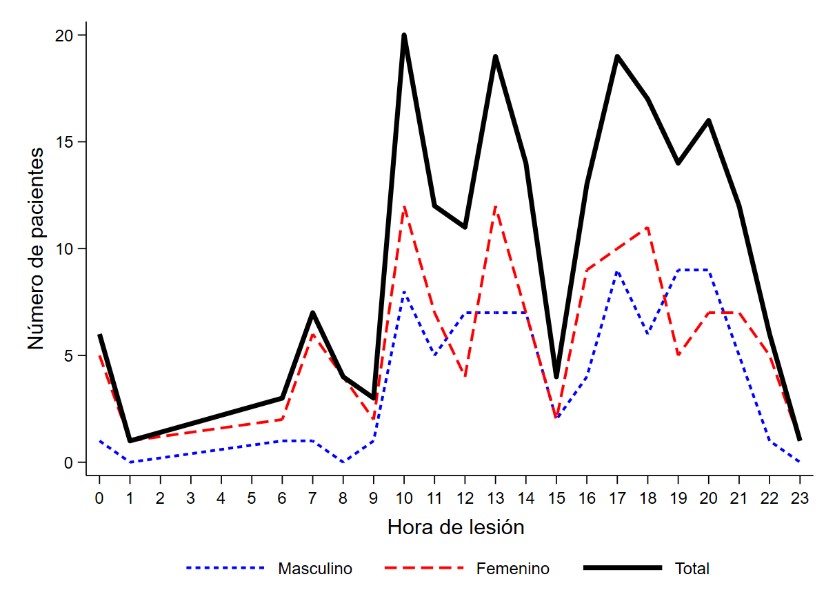
Objective: To describe the epidemiological profile and clinical characteristics of burns in pediatric patients treated at the National Institute of Child Health, in Lima, Peru, 2025. Materials and methods: An observational and descriptive study was conducted based on a review of the medical records of patients under 18 years of age diagnosed with burns and subsequently registered in the RELAQ platform. Sociodemographic, clinical, injury event-related, treatment, and outcome variables were collected. The analysis was descriptive using measures of central tendency and frequencies, with Stata v17. Results: Of the 202 patients, the majority were male (58.9%), with a median age of 3 years (IQR: 1–7), and 52.0% resided in Metropolitan Lima. A higher frequency of injuries was recorded in January, August, and December, and around 10:00 AM. The main causative agent was contact with hot liquids (77.2%), occurring in the home (70.8%). The majority received hospital care (94.6%) and were admitted for an acute event (72.8%). Small burns predominated (<10%), with the trunk being the most affected region (35.8%). 36.6% did not receive first aid at the time of the event. Conclusion: Burns primarily affected preschool-aged children and occurred mainly in the home environment, most often due to contact with hot liquids. The trunk was the most frequently affected body region. Most cases required hospital management and involved a low percentage of total body surface area burned. These findings highlight the need to strengthen prevention strategies and improve the quality of clinical records to optimize epidemiological surveillance.
Descargas
Referencias
Smolle C, Cambiaso-Daniel J, Forbes AA, Wurzer P, Hundeshagen G, Branski LK, Huss F, Kamolz LP. Recent trends in burn epidemiology worldwide: A systematic review. Burns. 2017; 43(2):249-257. doi: 10.1016/j.burns.2016.08.013.
Peck MD. Epidemiology of burns throughout the world. Part I: Distribution and risk factors. Burns. 2011;37(7):1087-100. doi: 10.1016/j.burns.2011.06.005.
Rybarczyk MM, Schafer JM, Elm CM, Sarvepalli S, Vaswani PA, Balhara KS, Carlson LC, Jacquet GA. Prevention of burn injuries in low- and middle-income countries: A systematic review. Burns. 2016;42(6):1183-92. doi: 10.1016/j.burns.2016.04.014.
Forbinake NA, Ohandza CS, Fai KN, Agbor VN, Asonglefac BK, Aroke D, Beyiha G. Mortality analysis of burns in a developing country: a CAMEROONIAN experience. BMC Public Health. 2020;20(1):1269. doi: 10.1186/s12889-020-09372-3.
Mock C, Peck M, Peden M, Krug E. A WHO Plan for Burn Prevention and Care. Geneva: World Health Organization; 2008. World Health Organization (WHO)
Sari H, Akkoc MF, Kilinç Z, Dayanir Çok FN, Özel M, Özel V. Investigation of morbidity, length of stay, and healthcare costs of inpatient paediatric burns. Int Wound J. 2024;21(1):e14385. doi: 10.1111/iwj.14385.
Mukerji G, Chamania S, Patidar GP, Gupta S. Epidemiology of pediatric burns in Indore, India. Burns. 2009; 27:33–38. doi: 10.1016/s0305-4179(00)00058-9.
Jordan KC, Di Gennaro JL, von Saint André-von Arnim A, Stewart BT. Global trends in pediatric burn injuries and care capacity from the World Health Organization Global Burn Registry. Front Pediatr. 2022;10:954995. doi: 10.3389/fped.2022.954995.
Martens S, Romanowksi K, Palmieri T, Greenhalgh D, Sen S. Massive Pediatric Burn Injury: A 10-Year Review. J Burn Care Res. 2023;44(3):670-674. doi: 10.1093/jbcr/irab201.
Zhao X, Zhuang Z, Jia Y, Liu X, Ni X, Chen K. Risk factors of mortality among pediatric burn patients: a systematic review and meta-analysis. Transl Pediatr. 2025;14(10):2417-2436. doi: 10.21037/tp-2025-444.
Nassar JY, Al Qurashi AA, Albalawi IA, Nukaly HY, Halawani IR, Abumelha AF, Osama Al Dwehji AM, Alhartani MM, Asaad A, Alnajashi A, Khojah IM. Pediatric Burns: A Systematic Review and Meta-Analysis on Epidemiology, Gender Distribution, Risk Factors, Management, and Outcomes in Emergency Departments. Cureus. 2023;15(11):e49012. doi: 10.7759/cureus.49012.
Dalal S, Miles MVP, Solis-Beach KJ, Thakur B, Suman-Vejas OE, Ryan CM, Stewart BT, Carrougher GJ, Orton C, Kowalske K. Assessing the generalizability of a National Burn Database to the United States pediatric burn injury population. PM&R. 2025;17(4):404-407. doi:10.1002/pmrj.13284
Jeschke MG, van Baar ME, Choudhry MA, Chung KK, Gibran NS, Logsetty S. Burn injury. Nat Rev Dis Primers. 2020;6(1):11. doi: 10.1038/s41572-020-0145-5.
Moi AL, Haugsmyr E, Heisterkamp H. Long-Term Study Of Health And Quality Of Life After Burn Injury. Ann Burns Fire Disasters. 2016;29(4):295-299.
Korzeniowski T, Mertowska P, Mertowski S, Podgajna M, Grywalska E, Strużyna J, Torres K. The Role of the Immune System in Pediatric Burns: A Systematic Review. J Clin Med. 2022;11(8):2262. doi: 10.3390/jcm11082262.
Sarginson JH, Hollén L, Emond A, Mackie I, Young AE. Multicentre observational study describing the systemic response to small-area burns in children. Burns. 2021;47(3):560-568. doi: 10.1016/j.burns.2020.07.020.
Sam, Aída Vásquez Yap, Padilla Érika Bravo, Sedano César Medrano. Características clínico Epidemiológicas de los pacientes con quemaduras antes y durante la pandemia por Covid-19 en el Instituto Nacional de Salud del Niño San Borja. Rev. Cuerpo Med. HNAAA. 2023; 16( 1 ): 78-82. doi:10.35434/rcmhnaaa.2023.161.1661.
Alharthi AF, Al Sulaiman K, Alotaibi S, Alqahtani R, Damfu N, Alharbi A, Alomair S, Alhaidal HA, Aljuhani O. Managing Infections in Burn Patients: Strategies and Considerations for Antimicrobial Dosing. Eur Burn J. 2025;6(4):53. doi: 10.3390/ebj6040053.
Price K, Lee KC, Woolley KE, Falk H, Peck M, Lilford R, Moiemen N. Burn injury prevention in low- and middle- income countries: scoping systematic review. Burns Trauma. 2021;9:tkab037. doi: 10.1093/burnst/tkab037.
Jacobs C, Vacek J, Many B, Bouchard M, Abdullah F. An Analysis of Factors Associated with Burn Injury Outcomes in Low- and Middle-Income Countries. J Surg Res. 2021;257:442-448. doi: 10.1016/j.jss.2020.08.019.
Registro Latinoamericano de Quemaduras (RELAQ). Corporación de Ayuda al Niño Quemado (COANIQUEM). Disponible en: https://relaq.org/
Cornejo-Luyo V, Alvarado-Tan M, Neciosup-Farge C, Ocsas-Pinedo D, SheenVargas C, Vallejos-Montoya J, et al. Características epidemiológicas de los pacientes quemados atendidos en los servicios de emergencias de establecimientos del Ministerio de Salud en Perú. An Fac med. 2025;86(1):55-60. doi:10.15381/anales.v86i1.30276
Elrod J, Schiestl CM, Mohr C, Landolt MA. Incidence, severity and pattern of burns in children and adolescents: An epidemiological study among immigrant and Swiss patients in Switzerland. Burns. 2019;45(5):1231-1241. doi: 10.1016/j.burns.2019.02.009.
Abedin M, Rahman FN, Rakhshanda S, Mashreky SR, Rahman AKMF, Hossain A. Epidemiology of non-fatal burn injuries in children: evidence from Bangladesh Health and Injury Survey 2016. BMJ Paediatr Open. 2022;6(1):e001412. doi: 10.1136/bmjpo-2022-001412.
Pelizzo G, Calcaterra V, Canonica CPM, Magenes VC, Marinaro M, Durante E, Cordaro E, Zuccotti G. Burns in Early Childhood: Age-Specific Causes, Risks, Management, and Implications-A Narrative Review. Children (Basel). 2025;12(11):1424. doi: 10.3390/children12111424.
Lee CJ, Mahendraraj K, Houng A, Marano M, Petrone S, Lee R, Chamberlain RS. Pediatric Burns: A Single Institution Retrospective Review of Incidence, Etiology, and Outcomes in 2273 Burn Patients (1995-2013). J Burn Care Res. 2016;37(6):e579-e585. doi: 10.1097/BCR.0000000000000362.
Battle CE, Evans V, James K, Guy K, Whitley J, Evans PA. Epidemiology of burns and scalds in children presenting to the emergency department of a regional burns unit: a 7-year retrospective study. Burns Trauma. 2016;4:19. doi: 10.1186/s41038-016-0047-7.
Zhou B, Zhou X, Ouyang LZ, Huang XY, Zhang PH, Zhang MH, Ren LC, Liang PF. An epidemiological analysis of paediatric burns in urban and rural areas in south central China. Burns. 2014;40(1):150-6. doi: 10.1016/j.burns.2013.04.020.
Özlü Ö, Başaran A. Epidemiology and outcome of 1442 pediatric burn patients: A single-center experience. Ulus Travma Acil Cerrahi Derg. 2022;28(1):57-61. doi: 10.14744/tjtes.2020.69447.
Banerjee S, Shumba C. A systematic review of epidemiological patterns and proposed interventions to address pediatric burns in Nigeria. Afr Health Sci. 2020;20(2):991-999. doi: 10.4314/ahs.v20i2.56.
Toma A, Voicu D, Popazu C, Mihalache D, Duca O, Dănilă DM, Enescu DM. Severity and Clinical Outcomes of Pediatric Burns-A Comprehensive Analysis of Influencing Factors. J Pers Med. 2024;14(8):788. doi: 10.3390/jpm14080788.
Villegas S, Angélica P, Schwaner A, Torres A, Claure P. Analysis of the epidemiological profile of pediatric burn patients hospitalized in referral centers in the north, center and south of Chile: A multicenter study. J Pediatr Surg Open. 2023;4:100101. doi:10.1016/j.yjpso.2023.100101.
Verey F, Lyttle MD, Lawson Z, Greenwood R, Young A. When do children get burnt? Burns. 2014;40(7):1322-8. doi: 10.1016/j.burns.2014.01.010.
Asena M, Akelma H, Salık F, Karahan ZA. The seasonal and monthly distribution of body limbs affected by burns in paediatric patients in southeast Turkey. Int Wound J. 2019;16(6):1273-1280. doi: 10.1111/iwj.13178.
Ghorbel I, Bouaziz F, Loukil K, Moalla S, Gassara M, Ennouri K. Epidemiological profile of burns in children in central and southern Tunisia: A 67-case series. Arch Pediatr. 2019;26(3):158-160. doi: 10.1016/j.arcped.2019.02.007.
Lin Z, Al-Saidi NAY, Lin J, Wu Y, Lan L, Huang C, Liang F, Huang Z. Epidemiology and burden of pediatric burns in underdeveloped minority areas in Guangxi, China from 2014 to 2020: a retrospective study. Front Public Health. 2025;13:1566173. doi: 10.3389/fpubh.2025.1566173.
Tran S, Holland AJA, Bertinetti M. Holiday hazards: burns in children during school holidays. ANZ J Surg. 2021;91(6):1159-1163. doi: 10.1111/ans.16746.
Descargas
Publicado
Número
Sección
Licencia
Derechos de autor 2026 Marga Carolina Callupe Gamarra, Edith Lourdes Sánchez Medina, María Elena Mendoza Mendocilla, Orlando Flores Guerrero

Esta obra está bajo una licencia internacional Creative Commons Atribución 4.0.