Ultra-processed food consumption and anxiety levels in school adolescents from a public educational institution in Lima, Peru
DOI:
https://doi.org/10.58597/rpe.v5i2.147Keywords:
Ultra-processed foods, Anxiety, Adolescents, Mental health, Diet, StudentsAbstract
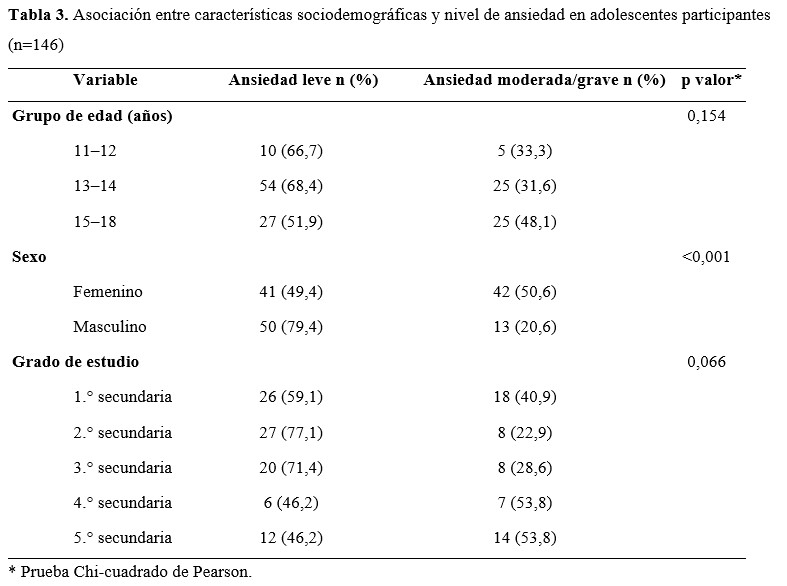
Objective: To evaluate the association between ultra-processed food consumption and anxiety levels in adolescents from a public educational institution in Lima, Peru. Materials and methods: An analytical cross-sectional study was conducted in 146 adolescents aged 11 to 18 years during 2022. UPF consumption was assessed using a food frequency questionnaire adapted for adolescents, and anxiety levels were evaluated using the Zung Self-Rating Anxiety Scale. The association between variables was assessed using the Chi-square test. Results: The predominant age group was 13–14 years (54.1%), and 56.8% of the participants were female. Low UPF consumption was observed in 71.2% of the sample, whereas 26.7% and 2.1% showed moderate and high consumption, respectively. Regarding anxiety levels, 62.3% of the participants presented mild anxiety, 36.3% moderate anxiety, and 1.4% severe anxiety. No significant association was identified between UPF consumption and anxiety levels (p = 0.411). However, a higher frequency of moderate and severe anxiety was observed among female adolescents (p < 0.001). Conclusions: No significant association was identified between UPF consumption and anxiety levels among the evaluated adolescents. Nevertheless, the high frequency of anxiety symptoms highlights the importance of strengthening comprehensive strategies promoting mental health and healthy eating in adolescent populations.
Downloads
References
World Health Organization. Adolescent mental health [Internet]. Geneva: WHO; 2021 [cited 2026 May 27]. Available from: https://www.who.int/news-room/fact-sheets/detail/adolescent-mental-health
El Peruano. Atenciones por salud mental aumentaron de 400 mil a un millón durante la pandemia [Internet]. Lima: El Peruano; 2023 [cited 2026 May 27]. Available from: https://elperuano.pe/noticia/203488-atenciones-por-salud-mental-aumentaron-de-400-mil-a-un-millon-en-pandemia
Catagua G, Escobar G. Anxiety in adolescents during confinement (COVID-19) in Santa Clara neighborhood, Manta, Ecuador. Polo Conoc. 2021;6(3):2094-110.
Ammar A, Brach M, Trabelsi K, Chtourou H, Boukhris O, Masmoudi L, et al. Effects of COVID-19 home confinement on eating behaviour and physical activity: results of the ECLB-COVID19 international online survey. Nutrients. 2020;12(6):1583.
Ammar A, Trabelsi K, Brach M, Chtourou H, Boukhris O, Masmoudi L, et al. Effects of home confinement on mental health and lifestyle behaviours during the COVID-19 outbreak: insights from the ECLB-COVID19 multicenter study. Biol Sport. 2021;38(1):9-21.
Pan American Health Organization. Ultra-processed food and drink products in Latin America: trends, impact on obesity, policy implications. Washington DC: PAHO; 2015.
Braden A, Musher-Eizenman D, Watford T, Emley E. Eating when depressed, anxious, bored, or happy: are emotional eating types associated with unique psychological and physical health correlates? Appetite. 2018;125:410-7.
Landaeta-Díaz L, González-Medina G, Agüero SD, González-Wong C, Canales-Johnson A, Gómez-Pérez C, et al. Anxiety, anhedonia and food consumption during the COVID-19 quarantine in Spanish-speaking Ibero-American countries: a cross-sectional study. SSM Popul Health. 2021;16:100902.
Di Renzo L, Gualtieri P, Pivari F, Soldati L, Attinà A, Cinelli G, et al. Psychological aspects and eating habits during COVID-19 home confinement: results of the EHLC-COVID-19 Italian online survey. Nutrients. 2020;12(7):2152.
Motoki K, Saito T, Nouchi R, Kawashima R, Sugiura M. Anxiety increases visual attention to hedonic foods: a preliminary eye-tracking study. Appetite. 2019;137:218-25.
Blanco-Gandía MC, González-Portilla M, Rodríguez-Arias M. Are ultra-processed foods a gateway to addiction? Mètode Sci Stud J. 2021;(11):139-45.
Coletro HN, Mendonça RDD, Meireles AL, Machado-Coelho GLL, Menezes MC. Ultra-processed and fresh food consumption and symptoms of anxiety and depression during the COVID-19 pandemic: COVID Inconfidentes study. Clin Nutr ESPEN. 2022;47:206-14.
Medina-Guillén LF, Cáceres Enamorado CR, Medina Guillén MF. Eating behaviors and physical activity associated with stress, anxiety and depression during the COVID-19 pandemic. MHSalud. 2022;19(2):1-18.
Reales-Moreno M, Sánchez-Villegas A, Fernández-Rodríguez R, Martínez-González MA, Bes-Rastrollo M. Ultra-processed foods and drinks consumption is associated with psychosocial functioning in adolescents. Nutrients. 2022;14(22):4765.
Faisal-Cury A, Leite MA, Escuder MML, Levy RB, Peres MFT. The relationship between ultra-processed food consumption and internalising symptoms among adolescents from São Paulo, Brazil. Public Health Nutr. 2022;25(9):2498-506.
Mukaka MM. Statistics corner: a guide to appropriate use of correlation coefficient in medical research. Malawi Med J. 2012;24(3):69-71.
Velásquez Castillo V, Palomino Quispe LP. Consumption of ultra-processed foods and beverages in adults during the quarantine period due to the COVID-19 pandemic [thesis]. Lima: Universidad Peruana Unión; 2020.
Zung WWK. A rating instrument for anxiety disorders. Psychosomatics. 1971;12(6):371-9.
Ruiz-Roso MB, de Carvalho Padilha P, Mantilla-Escalante DC, Ulloa N, Brun P, Acevedo-Correa D, et al. COVID-19 confinement and changes of adolescent dietary trends in Italy, Spain, Chile, Colombia and Brazil. Nutrients. 2020;12(6):1807.
Ruiz-Roso MB, de Carvalho Padilha P, Mantilla-Escalante DC, Ulloa N, Brun P, Acevedo-Correa D, et al. Changes of physical activity and ultra-processed food consumption in adolescents from different countries during COVID-19 pandemic: an observational study. Nutrients. 2020;12(8):2289.
Dhammawati F, Grahn A, Sarkadi A, Moraeus L, Lind T, Patterson E. Ultra-processed food versus fruit and vegetable consumption before and during the COVID-19 pandemic among Greek and Swedish students. Nutrients. 2023;15(10):2321.
Araneda J, Pinheiro AC, Pizarro T. Effects of COVID-19 pandemic on food insecurity perception in Chilean households. Rev Med Chil. 2021;149(7):980-8.
Downloads
Published
Issue
Section
License
Copyright (c) 2026 Isabella Canziani Garcia, Joseline Fernanda Mandujano Arellano, Fanny Elizabeth Requena Vela

This work is licensed under a Creative Commons Attribution 4.0 International License.