Adequacy of Food Group Intake and Dietary Habits in Children Aged 3 to 10 Years with Autism Spectrum Disorder in Lima, Peru, 2022-2023: A Cross-Sectional Study
DOI:
https://doi.org/10.58597/rpe.v5i3.161Keywords:
Autism Spectrum Disorder, Food Consumption, Feeding Behavior, Food Preferences, ChildAbstract
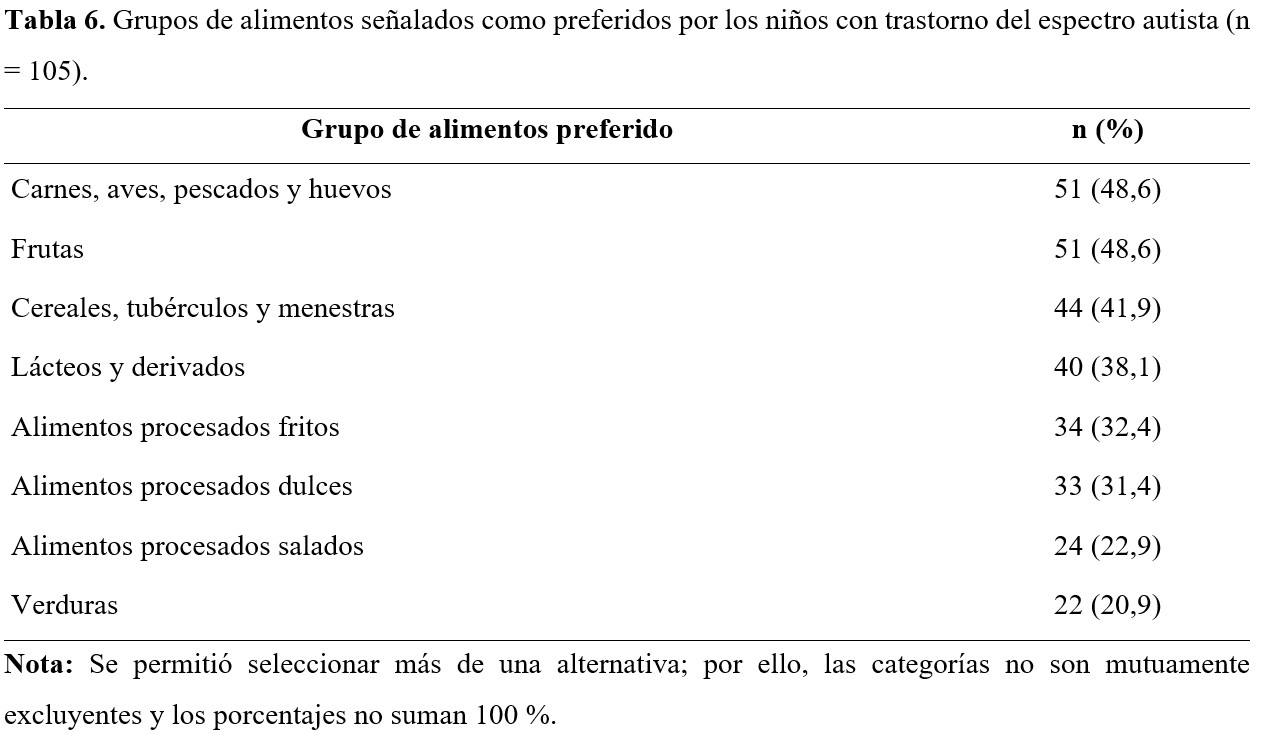
Introduction: Children with autism spectrum disorder (ASD) may exhibit food selectivity and specific mealtime behaviors, which may affect dietary variety. Objective: To describe the adequacy of food group intake and dietary habits in children aged 3 to 10 years with ASD in Metropolitan Lima, Peru, during 2022-2023. Methods: A descriptive cross-sectional observational study was conducted among 105 children with ASD. Mothers completed a self-administered online questionnaire. Food intake was estimated using a questionnaire based on the food consumption frequency structure of the National Center for Food and Nutrition (CENAN). Daily portions of seven food groups were compared with CENAN exchange ranges according to age. Dietary habits, behaviors, and preferences were assessed using questions based on specialized literature. Results: The median age was 4 years (IQR: 3-6), and 80.9% were male. Intake was below reference ranges for vegetables (76.2%), fruits (76.2%), dairy products (70.5%), and meat, fish, and eggs (71.4%). Overall, 61.9% exhibited specific mealtime behaviors, and 65.7% did not participate in food selection or preparation. The most frequently preferred food groups were meat, fish, and eggs, and fruits (48.6% each), whereas vegetables were the least preferred (20.9%). Conclusion: Low intake of several food groups and specific dietary behaviors and preferences were observed, highlighting the importance of considering these factors jointly when assessing the nutritional status of children with ASD.
Downloads
References
World Health Organization. Autism [Internet]. Geneva: World Health Organization; 2025 [citado 24 ago 2026]. Disponible en: https://www.who.int/news-room/fact-sheets/detail/autism-spectrum-disorders
Ministerio de Salud. Minsa fortalece la atención del autismo desde la detección temprana hasta el acompañamiento continuo [Internet]. Lima: Ministerio de Salud; 2026 [citado 24 ago 2026]. Disponible en: https://www.gob.pe/institucion/minsa/noticias/1374616-minsa-fortalece-la-atencion-del-autismo-desde-la-deteccion-temprana-hasta-el-acompanamiento-continuo
Rodrigues JVS, Poli MCF, Petrilli PH, Dornelles RCM, Turcio KH, Theodoro LH. Food selectivity and neophobia in children with autism spectrum disorder and neurotypical development: a systematic review. Nutr Rev. 2023;81(8):1034-1050. doi:10.1093/nutrit/nuac112.
Mirizzi P, Esposito M, Ricciardi O, Bove D, Fadda R, Caffò AO, et al. Food selectivity in children with autism spectrum disorder and in typically developing peers: sensory processing, parental practices, and gastrointestinal symptoms. Nutrients. 2025;17(17):2798. doi:10.3390/nu17172798.
Ahumada D, Guzmán B, Rebolledo S, Opazo K, Marileo L, Parra-Soto S, et al. Eating patterns in children with autism spectrum disorder. Healthcare (Basel). 2022;10(10):1829. doi:10.3390/healthcare10101829.
Plaza-Diaz J, Flores-Rojas K, de la Torre-Aguilar MJ, Gomez-Fernández AR, Martín-Borreguero P, Perez-Navero JL, et al. Dietary patterns, eating behavior, and nutrient intakes of Spanish preschool children with autism spectrum disorders. Nutrients. 2021;13(10):3551. doi:10.3390/nu13103551.
Buro AW, Gray HL, Kirby RS, Berkman K, Agazzi H, Shaffer-Hudkins E. Diet quality in an ethnically diverse sample of children and adolescents with autism spectrum disorder compared with nationally representative data. Disabil Health J. 2021;14(1):100981. doi:10.1016/j.dhjo.2020.100981.
Molina-López J, Leiva-García B, Planells E, Planells P. Food selectivity, nutritional inadequacies, and mealtime behavioral problems in children with autism spectrum disorder compared to neurotypical children. Int J Eat Disord. 2021;54(12):2155-2166. doi:10.1002/eat.23631.
Alhrbi A, Vlachopoulos D, Healey EM, Massoud AT, Morris C, Revuelta Iniesta R. Nutritional status of children diagnosed with autism spectrum disorder: a systematic review and meta-analysis. J Hum Nutr Diet. 2025;38(4). doi:10.1111/jhn.70099.
Esposito M, Mirizzi P, Fadda R, Pirollo C, Ricciardi O, Mazza M, et al. Food selectivity in children with autism: guidelines for assessment and clinical interventions. Int J Environ Res Public Health. 2023;20(6):5092. doi:10.3390/ijerph20065092.
Kozak A, Czepczor-Bernat K, Modrzejewska J, Modrzejewska A, Matusik E, Matusik P. Avoidant/restrictive food disorder (ARFID), food neophobia, other eating-related behaviours and feeding practices among children with autism spectrum disorder and in non-clinical sample: a preliminary study. Int J Environ Res Public Health. 2023;20(10):5822. doi:10.3390/ijerph20105822.
Baquerizo Tarazona KA, Díaz León MI. Ingesta dietética y valoración nutricional antropométrica en niños con trastorno del espectro autista de un centro educativo básico especial de San Borja–2020 [tesis de licenciatura]. Lima: Universidad Privada Norbert Wiener; 2021.
Ho HH, Eaves LC, Peabody D. Nutrient intake and obesity in children with autism. Focus Autism Other Dev Disabl. 1997;12(3):187-192. doi:10.1177/108835769701200308.
Tarqui-Mamani CB, Rojas-Macedo JA, Alvarez-Dongo D, Chávez-Ochoa HW, Aramburú-La Torre AM, Vásquez-Osorio SD, et al. Vigilancia de indicadores nutricionales: módulo de encuestadores. Lima: Instituto Nacional de Salud; 2013.
Lázaro-Serrano ML, Domínguez-Curi CH. Guía de intercambio de alimentos. Lima: Instituto Nacional de Salud; 2014.
Sharp WG, Postorino V, McCracken CE, Berry RC, Criado KK, Burrell TL, et al. Dietary intake, nutrient status, and growth parameters in children with autism spectrum disorder and severe food selectivity: an electronic medical record review. J Acad Nutr Diet. 2018;118(10):1943-1950. doi:10.1016/j.jand.2018.05.005.
Conti MV, Breda C, Basilico S, Ruggeri S, Scalvedi ML, Cena H. Unlocking the link: exploring the association between food selectivity and health outcome in autism spectrum disorder—a systematic review. Nutr Rev. 2026;84(3):584-599. doi:10.1093/nutrit/nuaf052.
Park HJ, Choi SJ, Kim Y, Cho MS, Kim YR, Oh JE. Mealtime behaviors and food preferences of students with autism spectrum disorder. Foods. 2021;10(1):49. doi:10.3390/foods10010049.
Huxham L, Marais M, van Niekerk E. Idiosyncratic food preferences of children with autism spectrum disorder in England. S Afr J Clin Nutr. 2021;34(3):90-96. doi:10.1080/16070658.2019.1697039.
Nadeau MV, Richard E, Wallace GL. The combination of food approach and food avoidant behaviors in children with autism spectrum disorder: “selective overeating”. J Autism Dev Disord. 2022;52(3):987-994. doi:10.1007/s10803-021-04945-6.
Gal E, Gal-Mishael R, Enten Vissoker R, Hedley D, Bury SM, Stolar O. Eating challenges in children with autism spectrum disorder: development and validation of the Aut-Eat Questionnaire (AEQ). J Autism Dev Disord. 2022;52(2):811-822. doi:10.1007/s10803-021-04978-x.
Downloads
Published
Issue
Section
License
Copyright (c) 2026 Sebastian Espinoza-Miranda, Allison González-Saldarriaga, Pamela Robles-Valcarcel

This work is licensed under a Creative Commons Attribution 4.0 International License.