Knowledge, attitudes and practices regarding sepsis in pediatrics: a cross-sectional study in general practitioners and medical students from latin american universities, 2022
DOI:
https://doi.org/10.58597/rpe.v3i3.61Keywords:
Sepsis, Knowledge, Attitudes and Health Practice, Medical Students, Physicians, PediatricsAbstract
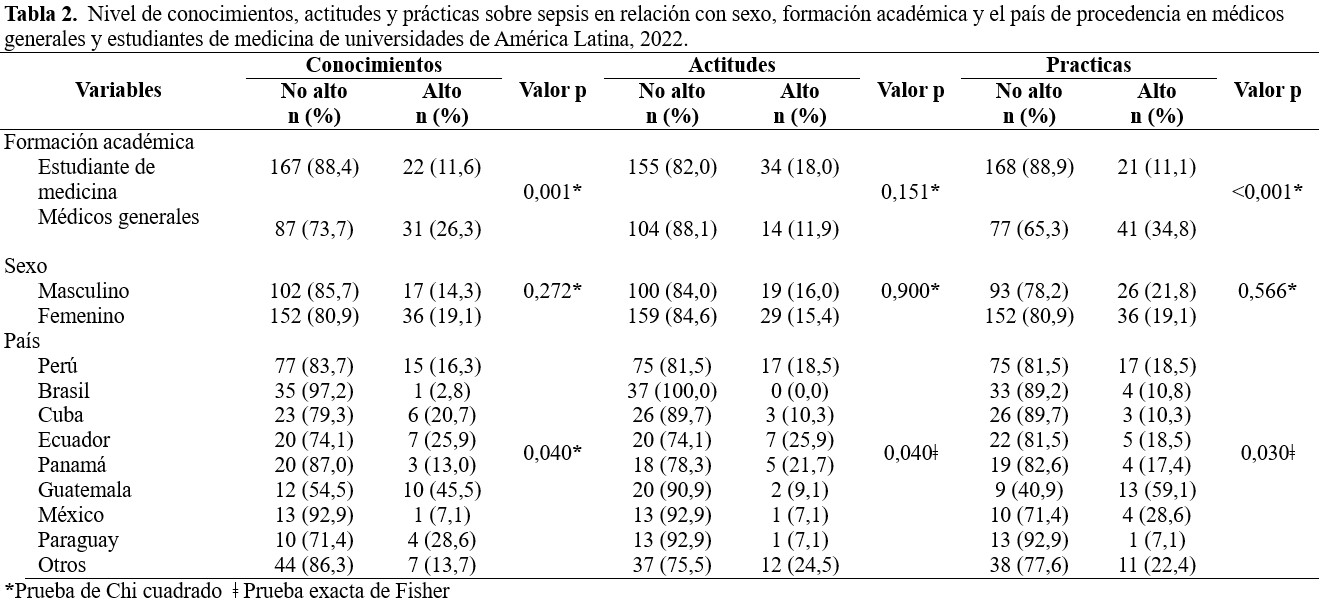
Objective: To assess the level of knowledge, attitudes and practices of general practitioners and medical students from Latin American universities regarding sepsis in pediatrics. Materials and methods: A cross-sectional descriptive study involving general practitioners and medical students from 35 universities across 16 Latin American countries, conducted between May and October 2022. A self-administered questionnaire was shared online upon acceptance of informed consent from participants. Data were analyzed using Stata v.16 software. Results: Out of 307 participants, 38.4% were general practitioners, 61.6% were medical students. In general, 17.3% achieved a high score on the knowledge test (general practitioners: 26.3%, medical students: 11.6%). Regarding attitudes, 15.6% obtained a high level (general practitioners: 11.9%, medical students: 18.0%). In practices related to sepsis management, 20.2% reached a high level (general practitioners: 34.8%, medical students: 11.1%). Significant differences were found between academic training and levels of knowledge (p = 0.001) and practices (p < 0.001). Conclusion: These results suggest that there are certain deficits among general practitioners and medical students in aspects related to the identification and management of sepsis in pediatrics. It may indicate the need to improve education on this disease during medical training, especially at the undergraduate level, to ensure better clinical preparation towards this disease.
Downloads
References
Zhang Z, Bokhari F, Guo Y, Goyal H. Prolonged length of stay in the emergency department and increased risk of hospital mortality in patients with sepsis requiring ICU admission. Emerg Med J. 2019; 36(2):82-7. doi: 10.1136/emermed-2018-208032
Copana R, Díaz W, Martínez, A, Tejerina M, Urquieta V, Casson N, et al. SIRS y qSOFA como Predictores de Mortalidad en Sepsis Pediátrica. Gaceta Médica Boliviana. 2021; 44(2): 154-61. doi: https://doi.org/10.47993/gmb.v44i2.265
Rudd KE, Johnson SC, Agesa KM, Shackelford KA, Tsoi D, Kievlan DR, et al. Global, regional, and national sepsis incidence and mortality, 1990-2017: analysis for the Global Burden of Disease Study. Lancet. 2020; 395(10219):200-211. doi: 10.1016/S0140-6736(19)32989-7.
Singer M, Deutschman CS, Seymour CW, Shankar-Hari M, Annane D, Bauer M, et al. The third international consensus definitions for sepsis and septic shock (sepsis-3). JAMA - J Am Med Assoc. 2016; 315(8):801–10. doi: 10.1001/jama.2016.0287.
Rhodes A, Evans LE, Alhazzani W, Levy MM, Antonelli M, Ferrer R, et al. Surviving sepsis Campaign: International Guidelines for Management of Sepsis and Septic Shock:2016. Intensive Care Med. 2017; 43:304-77. doi: 10.1007/s00134-017-4683-6.
Shankar-Hari M, Phillips GS, Levy ML, Seymour CW, Liu VX, Deutschman CS, et al. Developing a new definition and assessing new clinical criteria for septic shock: for the Third International Consensus Definitions for Sepsis and Septic Shock (Sepsis-3). JAMA. 2016; 315: 775-787. doi:10.1001/jama.2016.0289
Evans L, Rhodes A, Alhazzani W, Antonelli M, Coopersmith CM, French C, et al. Surviving sepsis campaign: international guidelines for management of sepsis and septic shock 2021. Intensive Care Med. 2021; 47(11):1181-1247. doi: 10.1007/s00134-021-06506-y.
Ferrer R, Martin-Loeches I, Phillips G, Osborn TM, Townsend S, Dellinger RP, Artigas A, et al. Empiric antibiotic treatment reduces mortality in severe sepsis and septic shock from the first hour: Results from a guideline-based performance improvement program. Crit Care Med. 2014; 42(8):1749–55. Doi: 10.1097/CCM.0000000000000330
Reinhart K, Daniels R, Kissoon N, et al. Recognizing sepsis as a global health priority - a WHO resolution. N Engl J Med. 2017;377(5):414–417. doi: 10.1056/NEJMp1707170.
WHO Sepsis Technical Expert Meeting - Meeting Report. Geneva: World Health Organization; 2018.
Yue J, Zhao H, Li J, Wu J, Zheng R. Knowledge, attitudes and practices towards the diagnosis and management of paediatric sepsis among paediatric physicians and nurses: a cross-sectional study of 21 hospitals in Hubei Province, China. BMJ Open. 2024;14(2):e079411. doi: 10.1136/bmjopen-2023-079411
Roye-Green K, Willis R, Priestley SR, Vickers I. Knowledge, Practice and Attitudes to the Management of Sepsis in Jamaica. J Crit Care Med (Targu Mures). 2022;8(4):232-241. doi: 10.2478/jccm-2022-0024
Chua WL, Teh CS, Basri MABA, Ong ST, Phang NQQ, Goh EL. Nurses' knowledge and confidence in recognizing and managing patients with sepsis: A multi-site cross-sectional study. J Adv Nurs. 2023; 79(2):616-629. doi: 10.1111/jan.15435
Pizarro CF, Troster EJ, Damiani D, Carcillo JA. Absolute and relative adrenal insufficiency in children with septic shock. Crit Care Med. 2005; 33(4):855-9. doi: 10.1097/01.ccm.0000159854.23324.84.
Tantaleán JA, León RJ, Santos AA, Sánchez E. Multiple organ dysfunction syndrome in children. Pediatr Crit Care Med. 2003; 4(2):181-5. doi: 10.1097/01.PCC.0000059421.13161.88.
Souza DC, Barreira ER, Shieh HH, Ventura AMC, Bousso A, Troster EJ. Prevalence and outcomes of sepsis in children admitted to public and private hospitals in Latin America: a multicenter observational study. Rev Bras Ter Intensiva. 2021; 33(2):231-242. doi: 10.5935/0103-507X.20210030.
Jaramillo-Bustamante JC, Marín-Agudelo A, Fernández-Laverde M, Bareño-Silva J. Epidemiology of sepsis in pediatric intensive care units: first Colombian multicenter study. Pediatr Crit Care Med. 2012; 13(5):501-8. doi: 10.1097/PCC.0b013e31823c980f.
Raupach-Rosin H, Duddeck A, Gehrlich M, Helmke C, Huebner J, Pletz MW, et al. Deficits in knowledge, attitude, and practice towards blood culture sampling: results of a nationwide mixed-methods study among inpatient care physicians in Germany. Infection. 2017; 45(4):433-441. doi: 10.1007/s15010-017-0990-7.
Dias DL, Kamat AS, Gomes SS, Gomes EJ, Bhounsule SA. Quantitative Analysis of Competency Levels in Medical Interns of a Tertiary Care Hospital in India - A questionnaire Based Cross Sectional Study. J Assoc Physicians India. 2019; 67(9):34-38.
Montalvan-Gonzales GL. Conocimientos y percepción sobre la sepsis en pediatría. Rev Med Electronica. 2009;31(6).
Thompson GC, Macias CG. Recognition and Management of Sepsis in Children: Practice Patterns in the Emergency Department. J Emerg Med. 2015; 49(4):391-9. doi: 10.1016/j.jemermed.2015.03.012.
Regina J, Le Pogam MA, Niemi T, Akrour R, Pepe S, Lehn I, Wasserfallen JB, Calandra T, Meylan S. Sepsis awareness and knowledge amongst nurses, physicians and paramedics of a tertiary care center in Switzerland: A survey-based cross-sectional study. PLoS One. 2023; 18(6):e0285151. doi: 10.1371/journal.pone.0285151
Breuer RK, Hassinger AB. Impact of a Multidisciplinary Sepsis Initiative on Knowledge and Behavior in a Pediatric Center. Pediatr Qual Saf. 2020 10;5(2):e267. doi: 10.1097/pq9.0000000000000267.
Choy CL, Liaw SY, Goh EL, See KC, Chua WL. Impact of sepsis education for healthcare professionals and students on learning and patient outcomes: a systematic review. J Hosp Infect. 2022; 122:84-95. doi: 10.1016/j.jhin.2022.01.004.
Gomersall ELM, Ling L, Reinhart K, Bion V, Ekesh A, Adu-Takyi C, et al. Core sepsis-related competencies for medical students: an international consensus by Delphi technique. BMC Med Educ. 2024; 24(1):653. doi: 10.1186/s12909-024-05525-9.
Nguyen HB, Daniel-Underwood L, Van Ginkel C, Wong M, Lee D, Lucas AS, Palaganas J, Banta D, Denmark TK, Clem K. An educational course including medical simulation for early goal-directed therapy and the severe sepsis resuscitation bundle: an evaluation for medical student training. Resuscitation. 2009; 80(6):674-9. doi: 10.1016/j.resuscitation.2009.02.021.
Niamsanit S, Saengthongpitag T, Uppala R, Sitthikarnkha P, Techasatian L, Saengnipanthkul S. Survey of Thai Physicians' Practice in Pediatric Septic Shock. Children (Basel). 2024; 11(5):597. doi: 10.3390/children11050597.
Marshall-Brown P, Namboya F, Pollach G. Evaluating sepsis training for medical students and nonphysicians in Malawi. J Clin Anesth. 2016; 34, 352-357. Doi: 10.1016/j.jclinane.2016.05.013
Chen YC, Chang SC, Pu C, Tang GJ. The impact of nationwide education program on clinical practice in sepsis care and mortality of severe sepsis: a population-based study in Taiwan. PLoS One. 2013; 8(10):e77414. doi: 10.1371/journal.pone.0077414.
Fleischmann-Struzek C, Goldfarb DM, Schlattmann P, Schlapbach LJ, Reinhart K, Kissoon N. The global burden of pediatric and neonatal sepsis: a systematic review. Lancet Respir Med. 2018; 6(3):223-230. doi: 10.1016/S2213-2600(18)30063-8.
Weiss SL, Fitzgerald JC, Pappachan J, Wheeler D, Jaramillo-Bustamante JC, Salloo A, et al. Epidemiología global de la sepsis grave pediátrica: el estudio de prevalencia, resultados y terapias de la sepsis. Am J Respir Crit Care Med. 2015; 191(10):1147-1157. doi: 10.1164/rccm.201412-2323OC.
Machado FR, Assunção MS, Cavalcanti AB, Japiassú A, Azevedo LC, Oliveira MC, et al. Sepsis in Latin America: current challenges for management and care. Am J Respir Crit Care Med. 2021; 203(6):765-768. doi: 10.1164/rccm.202008-3150ED.
Thompson GC, Macias CG, Susman MM, Wright JL, Arnold DH, Johnson MD, et al. Sepsis education: initial results of a national effort by the Surviving Sepsis Campaign. Crit Care Med. 2019; 47(1):75-81. doi: 10.1097/CCM.0000000000003494.
Harris N, Welch CE. Developing Cognitive Skills Through Active Learning: A Systematic Review of Health Care Professions. Athl Train Ed J. 2019; 14 (2): 135–148. Doi: 10.4085/1402135
Downloads
Additional Files
Published
Issue
Section
License
Copyright (c) 2024 Marcelo Galdos-Bejar, Cielo Cabanillas-Ramirez, Barbara Llave-Sangiacomo, Sarita Gonzales-Mayta, Lizset Candi Ballena-Cupe, Ana Lucia Diaz-Alvitez, Liliana Arriola-Montenegro, Piero Larco-Castilla, Raffo Escalante-Kanashiro

This work is licensed under a Creative Commons Attribution 4.0 International License.